 Brice Eliasse

Your project spec is finalized, the frontend framework is chosen, and the team is assembled. Then comes the critical decision that will define your development velocity, your team's morale, and your application's scalability for years: which backend technology do you build on? For many, the choice narrows down to two dominant yet fundamentally different paradigms: Node.js and Laravel. This isn't just about picking a language; it's about selecting an entire ecosystem, a philosophy for building software, and a long-term technical partnership.
This guide cuts through the hype. We'll move beyond simple feature lists to examine how each technology behaves under the pressure of real-world requirements. You'll learn how your team's existing skills, your application's data flow, and your organization's operational maturity should guide this architectural choice. By the end, you'll have a clear framework for deciding whether the asynchronous, JavaScript-everywhere world of Node.js or the structured, convention-driven elegance of Laravel is the right engine for your next backend.
The Core Architectural Divide: Event Loops vs. Structured MVC
Imagine you're building a dashboard that needs to fetch real-time analytics, process a file upload, and send a welcome email, all from a single user request. How your backend handles this concurrency is the first major fork in the road between Node.js and Laravel.
Node.js is built on Google's V8 engine and uses a single-threaded, non-blocking event loop. When that dashboard request comes in, Node.js doesn't wait for the database to return analytics. It fires off that query and immediately moves to handle the file upload stream. Each I/O operation is handled asynchronously with callbacks, Promises, or async/await syntax. This model is exceptionally efficient for I/O-heavy applications like APIs, chat apps, or collaborative tools where many operations are waiting on external services. The trade-off is that CPU-intensive tasks, like image resizing or complex data crunching, can block the entire event loop, bringing all concurrent requests to a halt.
Laravel's Synchronous, Request-Response Flow
Laravel, a PHP framework, follows a traditional multi-threaded or process-based model. Using PHP-FPM (FastCGI Process Manager) as a common setup, each HTTP request is typically handled by a dedicated PHP worker process. For our dashboard, the worker would process the steps sequentially: fetch analytics, then process the upload, then send the email, before sending the final response. This synchronous flow is straightforward to reason about and debug. Laravel elegantly structures this flow within the Model-View-Controller (MVC) pattern, providing clear places for business logic, data handling, and response formatting.
The framework's 'batteries-included' nature means that for common tasks like sending email, managing queues, or handling authentication, Laravel provides a unified, cohesive API. You don't shop for a dozen independent libraries; you use the tools Laravel provides, which are designed to work together seamlessly. This reduces decision fatigue and integration bugs but commits you more deeply to the Laravel way of doing things.

Evaluating Your Team's Reality: Skill Stack and Development Velocity
A senior backend developer once told me, "The best technology is the one your team can debug at 3 a.m." Abstract benchmarks matter less than how quickly your team can ship features and fix problems. This makes your team's composition and experience the most critical, yet often overlooked, selection criteria.
If your team is composed primarily of frontend JavaScript or React/Vue developers, Node.js presents a compelling advantage: a unified language across the stack. Context switching between JavaScript on the server and TypeScript on the client disappears. Code sharing becomes possible for validation logic, types, and utilities. Onboarding new full-stack developers is simpler. The ecosystem, powered by npm, is vast, but it requires careful curation. You'll spend time evaluating packages for database access (Prisma, Sequelize, Mongoose), API frameworks (Express, Fastify, NestJS), and authentication solutions. This freedom enables fine-tuning but demands strong architectural leadership to prevent a fragmented, inconsistent codebase.
The Laravel Developer Experience and "Convention Over Configuration"
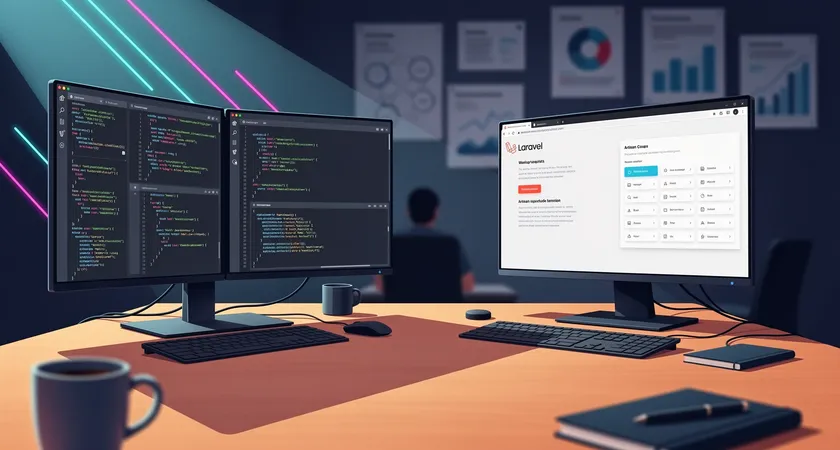
Laravel prioritizes developer happiness through consistency. Its Artisan command-line tool generates boilerplate code for models, controllers, and migrations. Database interactions are handled through the fluent, intuitive Eloquent ORM. The directory structure is prescribed. For teams with mixed experience levels, or where PHP is the dominant skill, this convention-over-configuration approach accelerates initial development and standardizes the codebase. A developer moving from one Laravel project to another can be productive almost immediately because the core patterns are familiar.
However, this comes with a learning curve specific to Laravel itself. A developer must learn Laravel's specific syntax for routing, middleware, service containers, and facades. While PHP as a language has evolved significantly, some perceptions of its older incarnations can linger, potentially affecting hiring. In practice, we've observed that Laravel teams often reach a stable, feature-complete MVP faster, especially for classic CRUD (Create, Read, Update, Delete) applications, due to the reduced number of foundational decisions required.
Performance in the Wild: Beyond "Hello World" Benchmarks
Synthetic benchmarks comparing raw requests per second are nearly useless for making this decision. Real-world performance depends on your application's specific profile: the ratio of I/O operations to CPU-intensive tasks, database query patterns, and caching strategy.
Node.js excels in scenarios requiring handling a massive number of concurrent, lightweight connections with low memory overhead per connection. Think of a notification service, a live comment feed, or an API gateway that proxies requests to other services. Its non-blocking nature allows it to hold tens of thousands of simultaneous connections waiting for database or API responses. For applications that are essentially orchestrators of other services, Node.js is often the performance winner.
Laravel, particularly when paired with OPcache and efficient database indexing, handles the typical request-response cycle of a web application, like an e-commerce site, a content management system, or a business dashboard, with more than sufficient performance for the vast majority of traffic loads. Where Laravel can stumble in naive implementations is with long-running requests that tie up worker processes. This is elegantly solved by offloading tasks to Laravel's built-in queue system using Redis or database drivers. A key performance practice in Laravel is to make HTTP responses fast by deferring any heavy lifting to background jobs.
The true bottleneck for both technologies, in most business applications, is rarely the raw speed of the framework. It's the database. An inefficient N+1 query problem in Eloquent or a poorly indexed MongoDB query in a Node.js app will dwarf any microsecond differences in framework overhead. Both ecosystems have mature tooling (Laravel Debugbar, Eloquent eager loading; Node.js async profilers, query loggers) to identify these issues.

Scalability and Maintenance: The Long-Term View
Two years after launch, your successful application now has a complex feature set, a growing user base, and new developers on the team. The cost of scaling and maintaining the initial technology choice becomes painfully clear. Here, the structural differences between Node.js and Laravel dictate different scaling paths.
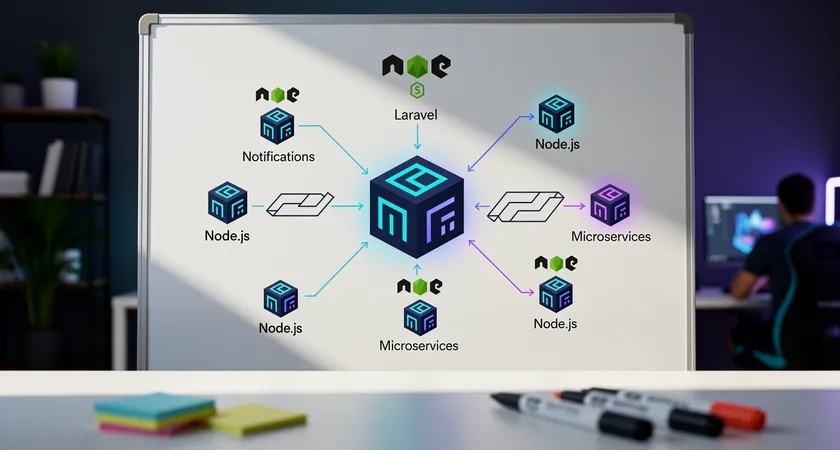
Scaling a Node.js application horizontally is conceptually straightforward due to its stateless nature. You can spin up multiple instances behind a load balancer. However, you must externalize state (using Redis or a database for sessions, socket.io adapters for websockets) from the start. The microservices pattern is a natural fit for Node.js, allowing you to decompose the application into small, focused services, each potentially using different Node.js libraries. This offers great flexibility but introduces the operational complexity of distributed systems: service discovery, inter-service communication, and consolidated logging.
Laravel's Monolithic Strength and Scaling Patterns
Laravel applications often begin as well-structured monoliths. This is not a weakness; a monolithic architecture is simpler to deploy, monitor, and debug for a large class of applications. Laravel scales vertically (a more powerful server) and horizontally (more PHP-FPM workers and web servers) effectively for monolithic workloads. As complexity grows, Laravel's service container and clear separation of concerns make it feasible to modularize the codebase internally.
For parts of the system that require high concurrency or specialized processing, a common pattern is to keep the core application in Laravel and offload specific tasks to dedicated microservices, perhaps written in Node.js or Go, communicating via queues or HTTP. Laravel's queue system is a robust and simple gateway for this pattern. From a maintenance perspective, Laravel's consistent structure and comprehensive documentation can make the codebase more approachable for new team members years later, reducing the "bus factor."
In maintenance audits, a frequent finding in DIY Node.js projects is "framework sprawl", a collection of disparate libraries glued together, each with its own lifecycle and breaking changes, leading to fragile and costly upgrades. Laravel projects, by virtue of a more integrated core, often show more upgrade stability, though major version upgrades still require careful planning and testing.
Making the Decision: A Practical Project Scoring Framework
So how do you move from theory to a definitive choice for your project? Don't just count pros and cons. Score your project against these practical dimensions. Assign points (e.g., 1-3) based on how strongly each factor aligns with one technology over the other.
Project Type & Requirements: Does your app need real-time features (chat, live updates, collaboration)? Node.js gets points. Is it a data-driven business application with complex forms, workflows, and reporting? Laravel gains an edge. Is it primarily a stateless API gateway or proxy? Node.js is likely stronger.
Team Composition: Does your team have deep JavaScript/TypeScript expertise but limited PHP experience? That's a strong signal for Node.js. Is your team proficient in PHP or comes from a .NET/Java background valuing structure? Lean towards Laravel. Are you building a new team and need to hire? Consider the local talent pool for each technology.
Development Timeline & Operational Maturity: Need to build a robust MVP incredibly fast with built-in solutions for auth, mailing, queues, and an admin panel? Laravel's starter kits and packages like Jetstream or Breeze can save months. Have more time for foundational architecture and enjoy selecting best-of-breed libraries for each concern? Node.js offers that freedom. Does your ops team have more experience managing PHP/Linux stacks or containerized Node.js services?
Long-term Evolution: Is the domain complex and likely to evolve into separate bounded contexts or services? Node.js's affinity for microservices might be prescient. Is the domain relatively stable and cohesive, better served by a single, well-organized codebase? A Laravel monolith could be the simpler, long-term bet.
No technology scores perfectly. The goal is to see a clear trend. A project scoring heavily in Laravel's column but choosing Node.js for perceived performance gains is taking a real risk that could manifest as slower development, higher bug rates, and team frustration.

Ultimately, the choice between Node.js and Laravel is rarely about one being objectively better. It's about which one is better for your specific context. Node.js delivers unparalleled efficiency for I/O-bound, real-time systems and offers JavaScript unification. Laravel provides a rapid, structured path to production for full-featured web applications with less upfront decision-making.
The most costly mistakes happen when this decision is made in a vacuum, based on a blog post about trends or a developer's personal preference, without a sober assessment of the team and project realities. If your internal scoring is close, or if the technical stakes are high for your business, this is precisely the moment to seek an external, experienced perspective. A qualified consultant can perform a short technical audit of your requirements, team, and goals, helping you avoid the multi-year commitment penalty of a poorly matched backend architecture. The right foundation isn't just about writing code today; it's about building a platform that can grow, adapt, and be maintained efficiently for the long haul.