 Brice Eliasse
Your team has just deployed a feature. A week later, a bug surfaces in production. The culprit is a small, overlooked line in a pull request that five people glanced at. The collective time lost in debugging and fixing exceeds the time spent developing the feature. This scenario is not an anomaly. Its a direct symptom of an ineffective code review process. To go deeper, you can also read Benefits Of Project Management In Web Teams.
Effective code review practices for teams are not a luxury or a bureaucratic checkbox. They are a critical engineering discipline that directly impacts software quality, team velocity, and developer growth. A good review process catches bugs, shares knowledge, and enforces architectural consistency. A bad one is a source of friction, delay, and technical debt. This guide moves beyond generic advice to provide actionable strategies for building a review process that teams will actually use and benefit from. To go deeper, you can also read Effective Use Of React And NextJS Stack.
We will examine how to structure a review for maximum impact, implement practical tools like checklists, cultivate a constructive review culture, and scale the process as your team grows. The goal is to transform code review from a bottleneck into your teams most reliable quality gate.
Structuring the Review: From Chaos to a Predictable Workflow
A common failure point is treating the review as an amorphous, open-ended discussion. Without structure, reviews drag on, focus drifts, and critical issues slip through. The first step is to define a clear, stage-gated workflow. This creates predictability and sets expectations for both authors and reviewers.
Start by agreeing on what triggers a review. The best practice is to review all changes, no matter how small. This includes configuration files, documentation updates, and minor bug fixes. Consistency here prevents the "it's just a one-line change" mentality that often introduces regression. Use your version control system's features, like protected branches, to enforce this rule mechanically. No code merges to your main development branch without at least one approval.
Defining Review Scope and Size
The single biggest predictor of a slow, poor-quality review is the size of the change. A pull request with 50 changed files and 3,000 added lines is functionally unreviewable. It becomes an exercise in trust, not analysis. Enforce a hard limit on pull request size. A practical guideline many teams adopt is that a change should be reviewable within 60 to 90 minutes. This often translates to under 400 lines of code, though the cognitive complexity matters more than raw line count.
Break large features into a series of small, incremental pull requests. Review the architectural skeleton first, perhaps as a draft PR that outlines interfaces and data flow. Then, review the implementation piece by piece. This not only makes reviews faster but also surfaces design flaws early, before substantial implementation effort is wasted. Encourage developers to structure their work with review in mind from the very first commit.
The Role of pre-Review Quality Gates
Before a human even looks at the code, automated systems should run. This is the pre-review checklist. A robust setup includes:
- Automated builds and test suites. The CI pipeline must pass. No reviewer should waste time on code that breaks existing functionality.
- Static code analysis. Linters and formatters (like ESLint, Prettier, Black) should run automatically, ensuring basic style and syntax consistency.
- Security and dependency scans. Tools can flag known vulnerabilities in imported libraries.
By automating these checks, you free up human reviewers to focus on what machines cannot judge: the logic, architecture, readability, and overall design of the solution. The review comment "your build is failing" is a waste of everyone's time.
Implementing the Review Checklist: Moving Beyond Style Nitpicks
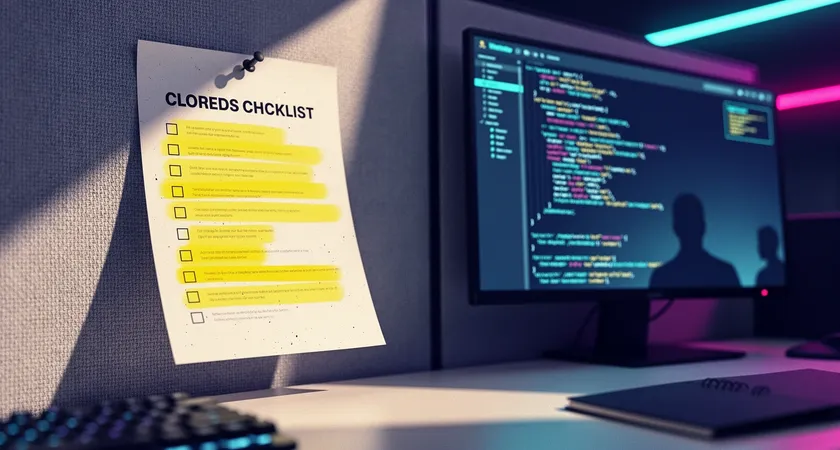
Imagine a reviewer who only comments on variable naming and comma placement. The author feels micromanaged, and critical flaws go unnoticed. To prevent this, teams need a shared framework for what to look for. A well-designed review checklist guides reviewers toward high-impact feedback and ensures consistency across the team.
Your checklist should be a living document, tailored to your project's maturity and common pain points. It should prioritize functional correctness and maintainability over subjective style debates. A typical checklist is organized by category.
The Functional Correctness Lens
This is the most important category. Reviewers must ask: does this code do what it's supposed to do? Start by examining the linked ticket or requirement. Does the implementation fulfill the acceptance criteria? Look for edge cases and error handling. Are null values, empty inputs, or network failures handled gracefully? Trace through critical logic flows step-by-step. A useful technique is for the author to add a comment briefly walking through the core algorithm, making the intent crystal clear for the reviewer.
Pay special attention to interactions with other parts of the system. Does a change in this service's API break a consumer elsewhere? Are database schema changes backwards compatible? These integration points are where many production issues originate.
The Maintainability and Clarity Lens
Will the developer who has to fix a bug at 3 a.m., six months from now, understand this code? Review for readability. Are functions small and single-purpose? Are variable and function names clear and unambiguous? Is the code self-documenting, or are there puzzling sections that require a clarifying comment?
Check for architecture adherence. Does the code follow the team's agreed-upon patterns for state management, data fetching, or component structure? Introducing a new library or pattern in a small PR might seem innocent, but it creates fragmentation. These decisions should be deliberate and discussed, not accidental.
Finally, consider testability. Is the logic overly entangled, making it hard to write unit tests? Are new tests included, and do they meaningfully verify behavior, not just implementation details? A pull request that adds complexity should almost always include corresponding tests.
Cultivating Review Culture: The Human Element of Technical Feedback
You can have the perfect workflow and checklist, but if the human interaction is toxic, the process will fail. Code review is a social contract. The author has made themselves vulnerable by sharing their work. The reviewer's job is to improve the code, not to prove they are smarter. Culture dictates whether a review comment is received as helpful guidance or as a personal attack.
The foundation of a good culture is psychological safety. Frame all feedback as a collaboration toward a better collective outcome, not as a judgment. Use "we" and "the code" instead of "you" and "your code." Instead of "You didn't handle the error here," try "Should we add error handling for a failed network call in this function?" This small shift in language makes a monumental difference in receptiveness.
The Art of Writing and Receiving Feedback
For reviewers, specificity is kindness. Vague comments like "This is messy" or "Make this better" are frustrating and unactionable. A good comment explains the *why* behind a suggestion. "Consider renaming this variable from `data` to `userProfile`. It's used throughout this function, and `data` is too generic, which might be confusing when we add other data objects later." This explains the reasoning and offers a concrete alternative.
For authors, the default stance should be gratitude, not defensiveness. Assume positive intent. If a comment is unclear, ask for clarification. If you disagree, explain your reasoning technically. The goal is not to win an argument but to arrive at the best technical solution. Sometimes, the best response to a review is to schedule a quick five-minute video call to whiteboard a complex issue instead of a lengthy, miscommunicative thread.
Publicly praise good feedback and clean code. When a reviewer spots a subtle race condition or an author writes an exceptionally clear test, acknowledge it in the team channel. This reinforces the behaviors you want to see and shows that the process is about excellence, not criticism.
Operationalizing the Process: Tools, Timing, and Metrics
With culture and structure in place, you need to make the process run smoothly day-to-day. This involves tooling, service level agreements (SLAs), and a light-touch approach to metrics. The objective is to reduce friction and make participation seamless.
Leverage your tools fully. Use review templates in your Git platform to auto-populate the description with sections for context, testing notes, and screenshots (for UI changes). Use threaded conversations to keep discussions organized. Embrace features like "approve with suggestions" or "request changes" to provide clear signals. Integrate your CI status directly into the PR view so everyone sees the same information.
Setting Expectations for Response Time
A pull request languishing for days is a major productivity killer. It context-switches the author and blocks their progress. Establish a team SLA for first response time. A common standard is that all PRs should receive a first review (or an acknowledgement of who will review) within 4 to 8 business hours. This doesn't mean the review must be *complete*, but someone has taken ownership.
Rotate review responsibilities if necessary to avoid bottlenecks. Some teams use a "pull request buddy" system or a dedicated reviewer rotation for each sprint. The key is to make it predictable. Authors should know roughly when to expect feedback, and reviewers should have protected time in their schedule to do reviews without sacrificing their own deep work.
Be cautious with metrics. Tracking the number of comments or average review time can create perverse incentives. You want thoughtful reviews, not fast, shallow ones or nitpicky, comment-heavy ones. A better metric is cycle time, from PR creation to merge. Focus on reducing the tail end of outliers, the PRs that take a week to get through. That's where process breakdowns are most visible.
Scaling and Evolving the Practice: Beyond the Core Team
The practices that work for a team of five co-located senior engineers will strain under a team of thirty distributed across time zones, or when multiple teams need to contribute to a shared codebase. Scaling code review requires additional coordination and sometimes, a recalibration of goals.
For cross-team reviews, clarity on ownership is paramount. When a PR touches multiple services, who is responsible for the final approval? A good pattern is the "owning team" model. The team that maintains the primary service or module affected has the final say. Other contributing teams review their specific changes, but the owning team ensures overall cohesion. Document these ownership boundaries explicitly in a `CODEOWNERS` file or a team directory.
As the organization grows, you may need to introduce a tiered review process. For mundane, low-risk changes (typos, dependency updates), a single automated check and a cursory review might suffice. For high-risk changes (core authentication, payment processing, major schema migrations), mandate reviews from two or more designated senior engineers. This risk-based approach applies scrutiny where it's most needed without bogging down every change.
Periodically, the process itself needs a review. Every six months, gather the team and ask: Is our checklist still relevant? Are our SLAs realistic? Where is the most friction? You might discover that certain types of changes are consistently problematic, indicating a need for better shared tooling or architectural guidelines. The most effective code review practices for teams are not static. They evolve with the codebase and the people who work on it.
The Limits of DIY and the Value of External Perspective
Many teams can implement a basic review workflow. They set up pull requests, agree to review each other's code, and see initial benefits. However, the deeper nuances that separate a good process from a great one often emerge only through experience or external observation. Teams can become blind to their own cultural drift or inefficient patterns.
For instance, a team might have a slow review cycle but attribute it to "being thorough." An external practitioner, however, might quickly identify that the root cause is unclear requirements at the ticket stage, leading to constant revision during review. Or, a team might struggle with consistent feedback quality. An experienced facilitator can run a review calibration workshop, where the team reviews the same sample pull request together, aligns on what constitutes high-priority feedback, and refines their shared checklist.
Similarly, scaling issues often benefit from an outside view. Designing a federated review model for multiple teams or integrating sophisticated automated quality gates requires knowledge of both best practices and practical tooling integrations that extend beyond daily development work. This is where the investment in specialized expertise pays off, not by replacing the team's process, but by auditing it, identifying the high-leverage improvements, and helping implement them sustainably. The goal is to build a system that is robust, respected, and truly effective at its core mission: shipping better software, together.
Effective code review is a hallmark of a mature engineering team. It is the deliberate practice that turns individual contributions into a coherent, maintainable codebase. By structuring the workflow, focusing feedback with checklists, nurturing a supportive culture, and diligently operating the process, teams can unlock its full potential. Remember, the output is not just approved code. It's shared understanding, continuous skill development, and a powerful collective defense against defects. Start by picking one area from this guide, whether it's enforcing smaller PRs, revamping your checklist, or having a conversation about feedback language, and implement it this week. The cumulative effect of these consistent, effective code review practices will compound, transforming the quality of your work and the health of your team.